






In the recent past, measurement of coverage has been mainly through two-stage cluster sampled surveys either as part of a nutrition assessment or through a specific coverage survey known as Centric Systematic Area Sampling (CSAS). However, such methods are resource intensive and often only used for final programme evaluation meaning results arrive too late for programme adaptation. SLEAC, which stands for Simplified Lot Quality Assurance Sampling Evaluation of Access and Coverage, is a low resource method designed specifically to address this limitation and is used regularly for monitoring, planning and importantly, timely improvement to programme quality, both for agency and Ministry of Health (MoH) led programmes. This package provides functions for use in conducting a SLEAC assessment.
The {sleacr} package provides functions that facilitate
the design, sampling, data collection, and data analysis of a SLEAC
survey. The current version of the {sleacr} package
currently provides the following:
Functions to calculate the sample size needed for a SLEAC survey;
Functions to draw a stage 1 sample for a SLEAC survey;
Functions to classify coverage;
Functions to determine the performance of chosen classifier cut-offs for analysis of SLEAC survey data;
Functions to estimate coverage over wide areas; and,
Functions to test for coverage homogeneity across multiple surveys over wide areas.
You can install {sleacr} from CRAN with:
install.packages("sleacr")You can install the development version of {sleacr} from
GitHub using the {pak} package with:
if (!require("pak")) install.packages("pak")
pak::pak("nutriverse/sleacr")
You can also install {sleacr} from the nutriverse R Universe
with:
install.packages(
  "sleacr",
  repos = c('https://nutriverse.r-universe.dev', 'https://cloud.r-project.org')
)To setup an LQAS sampling frame, a target sample size is first estimated. For example, if the survey area has an estimated population of about 600 severe acute malnourished (SAM) children and you want to assess whether coverage is reaching at least 50%, the sample size can be calculated as follows:
get_sample_n(N = 600, dLower = 0.5, dUpper = 0.8)which gives an LQAS sampling plan list with values for the target
minimum sample size (n), the decision rule
(d), the observed alpha error (alpha), and the
observed beta error (beta).
#> $n
#> [1] 19
#>
#> $d
#> [1] 12
#>
#> $alpha
#> [1] 0.06446194
#>
#> $beta
#> [1] 0.08014249
In this sampling plan, a target minimum sample size of 19 SAM cases should be aimed for with a decision rule of more than 12 SAM cases covered to determine whether programme coverage is at least 50% with alpha and beta errors no more than 10%. The alpha and beta errors requirement is set at no more than 10% by default. This can be made more precise by setting alpha and beta errors less than 10%.
There are contexts where survey data has already been collected and
the sample is less than what was aimed for based on the original
sampling frame. The get_sample_d() function is used to
determine the error levels of the achieved sample size. For example, if
the survey described above only achieved a sample size of 16, the
get_sample_d() function can be used as follows:
get_sample_d(N = 600, n = 16, dLower = 0.5, dUpper = 0.8)which gives an alternative LQAS sampling plan based on the achieved sample size.
#> $n
#> [1] 16
#>
#> $d
#> [1] 10
#>
#> $alpha
#> [1] 0.07890285
#>
#> $beta
#> [1] 0.1019738
In this updated sampling plan, the decision rule is now more than 10 SAM cases but with higher alpha and beta errors. Note that the beta error is now slightly higher than 10%.
The first stage sample of a SLEAC survey is a systematic spatial
sample. Two methods can be used and both methods take the sample from
all parts of the survey area: the list-based method and the
map-based method. The {sleacr} package currently
supports the implementation of the list-based method.
In the list-based method, communities to be sampled are selected
systematically from a complete list of communities in the survey area.
This list of communities should sorted by one or more non-overlapping
spatial factors such as district and subdistricts within districts. The
village_list dataset is an example of such a list.
village_list
#> # A tibble: 1,001 × 4
#>       id chiefdom section village
#>    <dbl> <chr>    <chr>   <chr>
#>  1     1 Badjia   Damia   Ngelehun
#>  2     2 Badjia   Damia   Gondama
#>  3     3 Badjia   Damia   Penjama
#>  4     4 Badjia   Damia   Jawe
#>  5     5 Badjia   Damia   Dambala
#>  6     6 Badjia   Fallay  Bumpewo
#>  7     7 Badjia   Fallay  Pelewahun
#>  8     8 Badjia   Fallay  Pendembu
#>  9     9 Badjia   Kpallay Jokibu
#> 10    10 Badjia   Kpallay Kpaku
#> # ℹ 991 more rows
The get_sampling_list() function implements the
list-based sampling method. For example, if 40 clusters/villages are
needed to be sampled to find the 19 SAM cases calculated earlier, a
sampling list can be created as follows:
get_sampling_list(village_list, 40)which provides the following sampling list:
| id | chiefdom | section | village |
|---|---|---|---|
| 20 | Badjia | Njargbahun | Kpetema |
| 45 | Bagbe | Jongo | Yengema |
| 70 | Bagbe | Samawa | Baiama |
| 95 | Bagbo | Jimmi | Kpawama |
| 120 | Bagbo | Mano | Dandabu |
| 145 | Baoma | Bambawo | Kenemawo |
| 170 | Baoma | Fallay | Gbandi |
| 195 | Baoma | Mawojeh | Ngelahun |
| 220 | Baoma | Upper Pataloo | Yakaji |
| 245 | Bumpe Ngao | Bumpe | Waiima |
| 270 | Bumpe Ngao | Foya | Bobobu |
| 295 | Bumpe Ngao | Bongo | Belebu |
| 320 | Bumpe Ngao | Serabu | Nyahagoihun |
| 345 | Bumpe Ngao | Taninahun | Kpetewoma |
| 370 | Bumpe Ngao | Taninahun | Mokebi |
| 395 | Bumpe Ngao | Taninahun | Ngiegboiya |
| 420 | Gbo | Gbo | Kotumahun Mavi |
| 445 | Gbo | Nyawa | Foya |
| 470 | Jaiama Bongor | Lower Niawa | Baraka |
| 495 | Jaiama Bongor | Tongowa | Talia |
| 520 | Jaiama Bongor | Upper Niawa | Nyeyama |
| 545 | Kakua | Kpandobu | Fabaina |
| 570 | Kakua | Nyallay | Jandama |
| 595 | Kakua | Sewa | Kenedeyama |
| 620 | Komboya | Kemoh | Gumahun |
| 645 | Komboya | Mangaru | Sengbehun |
| 670 | Lugbu | Kargbevu | Momandu |
| 695 | Niawa Lenga | Lower Niawa | Luawa |
| 720 | Niawa Lenga | Yalenga | Dandabu |
| 745 | Selenga | Mokpendeh | Jolu |
| 770 | Tikonko | Ngolamajie | Baoma (Geyewoma) |
| 795 | Tikonko | Seiwa | Gendema |
| 820 | Tikonko | Seiwa | Towama |
| 845 | Tikonko | Seiwa | Kpawugbahun |
| 870 | Valunia | Deilenga | Hendogboma |
| 895 | Valunia | Lower Kargoi | Gombu |
| 920 | Valunia | Lunia | Kpetema |
| 945 | Valunia | Manyeh | Malema |
| 970 | Valunia | Yarlenga | Dassamu |
| 995 | Wonde | Manyeh | Kigbema |
With data collected from a SLEAC survey, the
lqas_classify_coverage() function is used to classify
coverage. The {sleacr} package comes with the
survey_data dataset from a national SLEAC survey conducted
in Sierra Leone.
survey_data
#> # A tibble: 14 × 7
#>    country      province     district      cases_in cases_out rec_in cases_total
#>    <chr>        <chr>        <chr>            <int>     <int>  <int>       <int>
#>  1 Sierra Leone Northern     Bombali              4        26      6          30
#>  2 Sierra Leone Northern     Koinadugu            0        32      6          32
#>  3 Sierra Leone Northern     Kambia               0        28      0          28
#>  4 Sierra Leone Northern     Port Loko            2        28      0          30
#>  5 Sierra Leone Northern     Tonkolili            1        27      5          28
#>  6 Sierra Leone Eastern      Kono                 2        14      3          16
#>  7 Sierra Leone Eastern      Kailahun             4        30      3          34
#>  8 Sierra Leone Eastern      Kenema               8        26      4          34
#>  9 Sierra Leone Southern     Pujehun              6        21      1          27
#> 10 Sierra Leone Southern     Bo                   6        16      8          22
#> 11 Sierra Leone Southern     Bonthe               7        34      2          41
#> 12 Sierra Leone Southern     Moyamba              6        34      0          40
#> 13 Sierra Leone Western Area Western Area…        6        40      5          46
#> 14 Sierra Leone Western Area Western Area…        2        18      0          20
Using this dataset, per district coverage classifications can be calculated as follows:
with(
  survey_data,
  lqas_classify(
    cases_in = cases_in, cases_out = cases_out, rec_in = rec_in
  )
)
which outputs the following results:
#>    cf tc
#> 1   0  1
#> 2   0  0
#> 3   0  0
#> 4   0  0
#> 5   0  0
#> 6   0  1
#> 7   0  0
#> 8   1  1
#> 9   1  1
#> 10  1  1
#> 11  0  0
#> 12  0  0
#> 13  0  0
#> 14  0  0
The function provides estimates for case-finding
effectiveness and for treatment coverage as a
data.frame object.
It is useful to be able to assess the performance of the classifier chosen for a SLEAC survey. For example, in the context presented above of an area with a population of 600, a sample size of 40 and a 60% and 90% threshold classifier, the performance of this classifier can be assessed by first simulating a population and then determining the classification probabilities of the chosen classifier on this population.
## Simulate population ----
lqas_sim_pop <- lqas_simulate_test(
  pop = 600, n = 40, dLower = 0.6, dUpper = 0.9
)

## Get classification probabilities ----
lqas_get_class_prob(lqas_sim_pop)
#>                     Low : 0.9552
#>                Moderate : 0.8326
#>                    High : 0.8379
#>                 Overall : 0.9067
#> Gross misclassification : 0
This diagnostic test can also be plotted.
plot(lqas_sim_pop)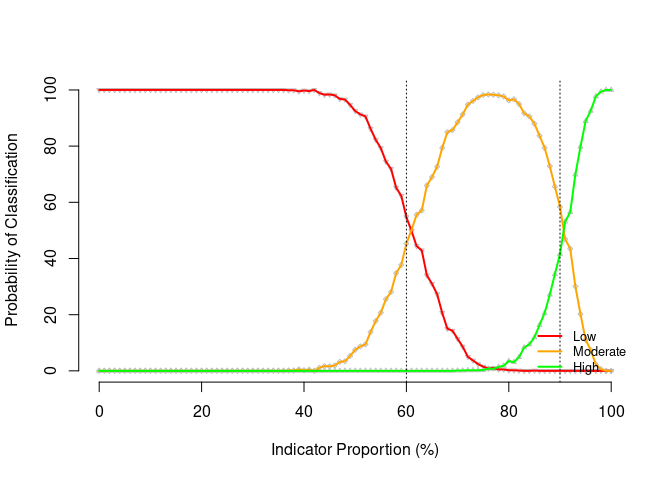
When SLEAC is implemented in several service delivery units, it is
also possible to estimate an overall coverage across these service
delivery units. For example, using the survey_data dataset
from a national SLEAC survey conducted in Sierra Leone, an overall
coverage estimate can be calculated. For this, additional information on
the total population for each service delivery unit surveyed will be
needed. For the Sierra Leone example, the pop_data dataset
gives the population for each district in Sierra Leone.
pop_data
#> # A tibble: 14 × 2
#>    district               pop
#>    <chr>                <dbl>
#>  1 Kailahun            526379
#>  2 Kenema              609891
#>  3 Kono                506100
#>  4 Bombali             606544
#>  5 Kambia              345474
#>  6 Koinadugu           409372
#>  7 Port Loko           615376
#>  8 Tonkolili           531435
#>  9 Bo                  575478
#> 10 Bonthe              200781
#> 11 Moyamba             318588
#> 12 Pujehun             346461
#> 13 Western Area Rural  444270
#> 14 Western Area Urban 1055964
The overall coverage estimate can be calculated as follows:
pop_df <- pop_data |>
  setNames(nm = c("strata", "pop"))

estimate_coverage_overall(
  survey_data, pop_data, strata = "district", u5 = 0.177, p = 0.01
)
which gives the following results:
#> $cf
#> $cf$estimate
#> [1] 0.1257481
#>
#> $cf$ci
#> [1] 0.09247579 0.15902045
#>
#>
#> $tc
#> $tc$estimate
#> [1] 0.1706466
#>
#> $tc$ci
#> [1] 0.1371647 0.2041284When estimating coverage across multiple surveys over wide areas, it
is good practice to assess whether coverage across each of the service
delivery units is homogenous. The function
check_coverage_homogeneity() is used for this purpose:
check_coverage_homogeneity(survey_data)which results in the following output:
#> ℹ Case-finding effectiveness across 14 surveys is not patchy.
#> ! Treatment coverage across 14 surveys is patchy.
#> $cf
#> $cf$statistic
#> [1] 20.1292
#>
#> $cf$df
#> [1] 13
#>
#> $cf$p
#> [1] 0.09203514
#>
#>
#> $tc
#> $tc$statistic
#> [1] 33.10622
#>
#> $tc$df
#> [1] 13
#>
#> $tc$p
#> [1] 0.001642536
In this example, case-finding effectiveness is homogeneous while treatment coverage is patchy.
If you use the {sleacr} package in your work, please
cite both the {sleacr} package and the authors and
developers of the SQUEAC and SLEAC method.
A suggested citation for both is provided by a call to the
citation() function as follows:
citation("sleacr")
#> To cite sleacr in publications use:
#>
#>   Ernest Guevarra, Mark Myatt (2026). _sleacr: Simplified Lot Quality
#>   Assurance Sampling Evaluation of Access and Coverage (SLEAC) Tools_.
#>   doi:10.5281/zenodo.7510931 <https://doi.org/10.5281/zenodo.7510931>,
#>   R package version 0.1.3, <https://nutriverse.io/sleacr/>.
#>
#> To cite the SQUEAC and SLEAC Technical Reference in publications use:
#>
#>   Mark Myatt, Ernest Guevarra, Lionella Fieschi, Allison Norris, Saul
#>   Guerrero, Lilly Schofield, Daniel Jones, Ephrem Emru, Kate Sadler
#>   (2012). _Semi-Quantitative Evaluation of Access and Coverage
#>   (SQUEAC)/Simplified Lot Quality Assurance Sampling Evaluation of
#>   Access and Coverage (SLEAC) Technical Reference_. FHI 360/FANTA,
#>   Washington, DC.
#>
#> To see these entries in BibTeX format, use 'print(<citation>,
#> bibtex=TRUE)', 'toBibtex(.)', or set
#> 'options(citation.bibtex.max=999)'.Feedback, bug reports, and feature requests are welcome; file issues or seek support here. If you would like to contribute to the package, please see our contributing guidelines.
This project is released with a Contributor Code of Conduct. By contributing to this project, you agree to abide by its terms.
